
Italy
Gunmaking districts, proof and makers.
Gunmaking here
Val Trompia’s iron and manganese deposits and its streams supported metalworking from the Middle Ages.1 In workshops along the watercourses, water wheels drove the forge hammers and bellows.1 A dispatch of 1459 records an order to produce firearms for the Venetian Republic, and in 1526 Bartolomeo Beretta of Gardone supplied 185 harquebus barrels to the Venice Arsenal.2, 3, 4, 5
The trade grew through specialised workshops, family ties and guilds, in a network centred on Gardone that extended down the Mella River to Brescia.6 Gardone made the barrels, while Marcheno, Sarezzo and Lumezzane supplied the gunlocks.7 In Brescia, engravers and etchers decorated stocks and barrels for wealthy civilian customers.8 The family workshops trained apprentices under a master gunsmith.9
Orders for barrels rose with Venetian military expansion and fell in peacetime.10 Venice protected the trade, but that protection could also keep its workshops from finding other buyers when government orders declined.11 In 1588 Venetian funds supported warehouses in Gardone that bought raw iron for the masters and stored finished goods until orders arrived.11 In 1627 the Republic forbade Gardone’s masters to teach barrel manufacture to anyone from outside Val Trompia.12 Gardone’s workers formed the Collegio delle Maestranze in 1726, and in 1740 the Senate reserved the trade in barrels and accessories to the college and placed quality under a procurator’s supervision.13
The political change of 1797 brought local arms production into France’s military organisation.14 Viceroy Eugenio Beauharnais visited the district on 29 December 1806 and then decided to open a royal arsenal in Brescia with a base in Gardone.14 In 1818 the Austrian authorities suspended production at Gardone’s state factory, reduced it to a store and transferred military contracts to merchant-entrepreneurs.15, 16 Vittorio Emanuele II reopened the arsenal as the Fabbrica Erariale di Brescia in 1859, and the Kingdom of Italy revived the local arsenal sites and introduced new production technology.17, 16
Private firms also brought the separate stages of manufacture together to make complete firearms, with Bernardelli following Glisenti and Beretta.18 Beretta introduced steam machinery in the nineteenth century but kept handwork for critical assembly and finishing.19 The First World War increased production sharply; peace brought contraction and long delays in adopting newer production methods.20 During the Second World War the large firms concentrated production through mechanisation and integration, and hunting-gun manufacture disappeared from the district.21 In 1945 the end of military contracts brought Gardone and the neighbouring villages close to industrial collapse.22
Hunting and sporting shotguns then gave the district a new market and a means of recovery.23 Side-by-sides led the recovery in the 1950s, and over-and-unders led local production in the 1960s.24 New workshops and small companies multiplied in those decades and formed a decentralised system for making hunting and sporting guns.25 Barrel makers, polishers, chequerers, engravers and assemblers worked both inside factories and as independent subcontractors.26 At Beretta and Bernardelli, profitable military contracts also financed investment in the 1950s that benefited civilian manufacture.27
Foreign markets helped the sector revive as Italy joined NATO in 1949 and GATT in 1950.28 During the 1960s the United States, France, Germany and the United Kingdom took more than 70 per cent of Brescia’s civilian firearm exports.29 In the early 1960s ArtArm began organising small gunmakers for overseas sales, first to Greece.30 Its successor became the Community of Small Gunmakers in 1970 and a consortium in 1975.31
Benelli Armi was founded in Urbino in 1967, and its plant was built and began production in 1968.32, 33 Benelli’s 2024 report records a further 1,000 square metres repurposed for manufacturing.34 In 2023, according to ANPAM’s December 2024 release, exports took 87 per cent of the industrial production value of civilian sporting, hunting and personal-defence arms and ammunition.35, 36
Districts
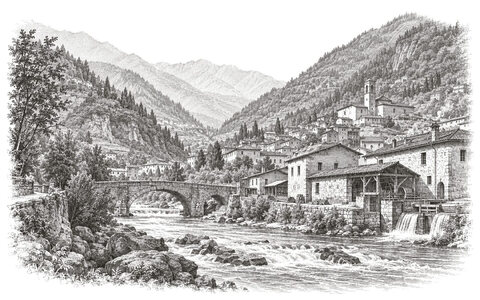
Gardone Val Trompia
Water from the Mella powered Gardone’s hammers, bellows and mechanical lathes.37 When Beretta introduced steam machinery, artisans continued the important assembly and finishing work.19 Zoli’s company address is in Gardone Val Trompia.38 The Zanardelli vocational school grew from a night and holiday school opened in 1860 and gained official recognition in 1902.39 Its postwar gunsmithing course combined practical gunmaking, machine tools, welding and engravingEngraving is decoration cut into a gun’s metal surfaces.Glossary: Engraving with drawing, engineering and general education.40
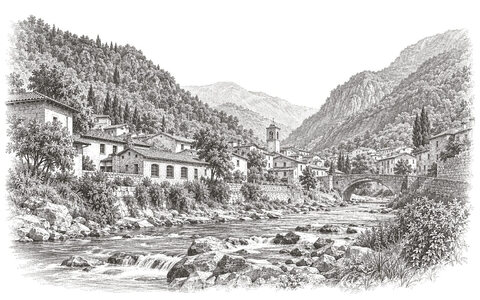
Marcheno
Marcheno’s gunlock workshops formed part of the valley’s division of labour.7 Rizzini gives its address in Marcheno and describes its craft traditions continuing alongside industrial investment.41, 42 Caesar Guerini began in a small Marcheno facility, making hunting and target over-and-unders and a semi-automaticA semi-automatic reloads itself after each shot and fires once for each pull of the trigger.Glossary: Semi-automatic hunting gun in 2001.43 Its new headquarters opened in 2006, with departments for computer-controlled machining, dimensional inspection and assembly.44, 45
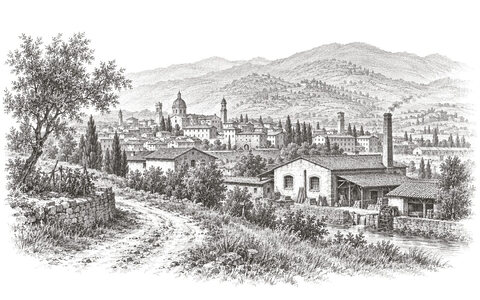
Brescia
Brescia’s finishing workshops engraved and etched stocks and barrels for wealthy civilian customers.8 The city housed the Napoleonic arsenal and, from 1859, the reopened state factory.14, 17 Franchi opened a new factory in Brescia in 1966.46 Fabarm, short for Fabbrica Bresciana di Armi, began with the Galesi family around 1900.47
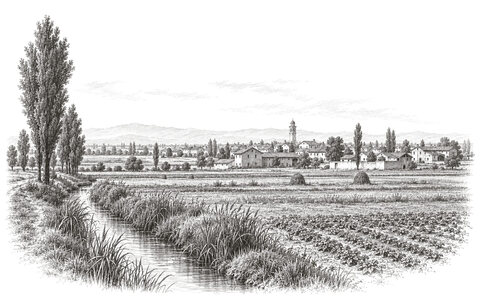
Travagliato
Fabarm changed ownership when Luciano Galesi retired in 1979.48 A few years later the new owners moved the business from Brescia to larger, modern buildings at Travagliato.48 Caesar Guerini became Fabarm’s sole shareholder in December 2015, and the group strengthened its American presence through Fabarm USA in Maryland.49, 50
Botticino
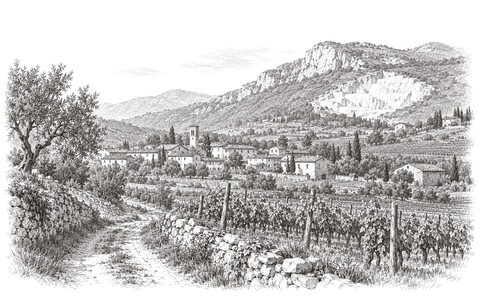
Perazzi occupies its own industrial complex at Botticino, in the province of Brescia.51 The complex covers 20,000 square metres, including a production plant of 9,000 square metres.51 Its departments include barrel making, woodwork, machining, assembly, heat treatment, bluingBluing is a controlled chemical rusting process that gives steel a dark finish.Glossary: Bluing and shotgun testing.52
Urbino
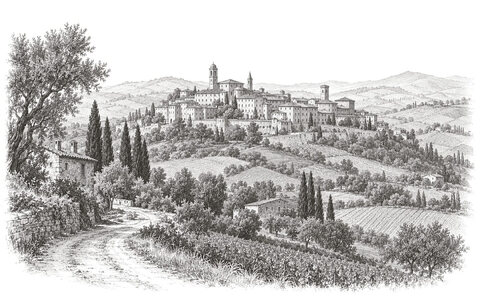
The Benelli brothers founded Benelli Armi in Urbino in 1967 and built its plant the following year.32, 33 Benelli firearms are conceived and produced in Urbino.53 In 1997 Benelli obtained a licence for a branch hosting the National Proof HouseA proof house tests firearms with proof ammunition and stamps them with the matching marks.Glossary: Proof house in Urbino.54 Franchi also gives its contact address in Urbino and describes itself as a division of Benelli Armi.55, 56
Proof and marks
Royal Decree No. 20 of 13 January 1910 established the proof institution.57 Bureaucratic delays and the First World War postponed the start of work at Gardone until September 1920 and at Brescia until July 1921.58 Proof became compulsory in 1923.58 The Brescia section closed in 1930, and the Gardone premises moved to Via Mameli in 1951.59
Shotgun proof marksProof marks are stamps on a gun that record the proof tests it has passed.Glossary: Proof marks appear beneath the rear of the barrels and on the actionThe action houses the mechanism that loads, fires and unloads a gun.Glossary: Action.60 The official marks distinguish ordinary smokeless proof, steel-shot proofSteel-shot proof tests a gun for use with high-performance steel-shot ammunition.Glossary: Steel-shot proof and reproof.61, 62, 63 The year stamp records the year of proof.64 Its code sequence begins with X for 1954 and changes to AA in 1975.65
From 1 June 2020 the proof house adopted the year’s last two digits in a rectangle.66, 67 CZ applies up to 31 May 2020, and 20 from 1 June.65 A separate year stamp may be omitted when the gun’s marked year of manufacture or import matches its proof year.68, 69
Banco Nazionale di Prova
| Code | Proof year | Code | Proof year | Code | Proof year | Code | Proof year |
|---|---|---|---|---|---|---|---|
| X | 195465 | XX9 (also XXIX70) | 197365 | BB | 199265 | CH | 201165 |
| XI | 195565 | XXX | 197465 | BC | 199365 | CI | 201265 |
| XII | 195665 | AA | 197565 | BD | 199465 | CL | 201365 |
| XIII | 195765 | AB | 197665 | BF | 199565 | CM | 201465 |
| XIV | 195865 | AC | 197765 | BH | 199665 | CN | 201565 |
| XV | 195965 | AD | 197865 | BI | 199765 | CP | 201665 |
| XVI | 196065 | AE | 197965 | BL | 199865 | CS | 201765 |
| XVII | 196165 | AF | 198065 | BM | 199965 | CT | 201865 |
| XVIII | 196265 | AH | 198165 | BN | 200065 | CU | 201965 |
| XIX | 196365 | AI | 198265 | BP | 200165 | 20 | 202065 |
| XX | 196465 | AL | 198365 | BS | 200265 | CZ | 202065 |
| XXI | 196565 | AM | 198465 | BT | 200365 | 21 | 202165 |
| XXII | 196665 | AN | 198565 | BU | 200465 | 22 | 202265 |
| XXIII | 196765 | AP (also AO70) | 198665 | BZ | 200565 | 23 | 202365 |
| XXIV | 196865 | AS | 198765 | CA | 200665 | 24 | 202465 |
| XXV | 196965 | AT | 198865 | CB | 200765 | 25 | 202565 |
| XXVI | 197065 | AU | 198965 | CC | 200865 | 26 | 202665 |
| XX7 (also XXVII70) | 197165 | AZ | 199065 | CD | 200965 | ||
| XX8 (also XXVIII70) | 197265 | BA | 199165 | CF | 201065 |
Makers
Beretta traces its recorded origins to Bartolomeo Beretta’s supply of barrels to Venice in 1526.3, 4, 5 The Luigi Franchi arms factory was founded in 1868 and joined the Beretta Group at the end of 1995.71, 72 Fabarm began with the Galesi family around 1900, and after the war it added over-and-unders and barrels for other brands to its work.47, 73 Antonio Zoli re-established his company on 1 October 1945 after the wartime interruption and developed it from a small workshop into an industrial business.74
Daniele Perazzi founded Armi Perazzi in 1957, and Battista Rizzini founded Rizzini in 1966.75, 76 The Benelli brothers founded Benelli Armi in Urbino in 1967.32 Caesar Guerini began shotgun production in Marcheno in 2001.43
Sources
- Gardone forges and the Museum of Arms: full chapter, minerals-and-hydraulic-power. Barbara Scala / University of Brescia; Stati Generali del Patrimonio Industriale, 2026. book
- Gardone forges and the Museum of Arms: full chapter, documented-firearms. Barbara Scala / University of Brescia; Stati Generali del Patrimonio Industriale, 2026. book
- Our History, barrel-maker. Beretta Holding. maker website
- Our History, recorded-sale. Beretta Holding. maker website
- Our History, year. Beretta Holding. maker website
- Surviving peace: the Italian gun-making district, 1945–1970, workshop-network. Riccardo Semeraro and José Antonio Miranda / Business History, 2023. magazine
- Local systems of production: firearms in Gardone Val Trompia, division-of-work. Riccardo Semeraro / University of Verona, 2017. book
- Local systems of production: firearms in Gardone Val Trompia, brescia-finishing. Riccardo Semeraro / University of Verona, 2017. book
- Gardone forges and the Museum of Arms: full chapter, family-workshops. Barbara Scala / University of Brescia; Stati Generali del Patrimonio Industriale, 2026. book
- Gardone: Venetian rule and the arms trade, venetian-demand. Gardone Val Trompia municipal visitor website. maker website
- Gardone forges and the Museum of Arms: full chapter, venetian-protection-and-credit. Barbara Scala / University of Brescia; Stati Generali del Patrimonio Industriale, 2026. book
- Gardone forges and the Museum of Arms: full chapter, protected-knowledge. Barbara Scala / University of Brescia; Stati Generali del Patrimonio Industriale, 2026. book
- Gardone forges and the Museum of Arms: full chapter, guild-and-quality-control. Barbara Scala / University of Brescia; Stati Generali del Patrimonio Industriale, 2026. book
- Local systems of production: firearms in Gardone Val Trompia, napoleonic-arsenal. Riccardo Semeraro / University of Verona, 2017. book
- Local systems of production: firearms in Gardone Val Trompia, austrian-closure. Riccardo Semeraro / University of Verona, 2017. book
- Surviving peace: the Italian gun-making district, 1945–1970, state-modernisation. Riccardo Semeraro and José Antonio Miranda / Business History, 2023. magazine
- Local systems of production: firearms in Gardone Val Trompia, italian-reopening. Riccardo Semeraro / University of Verona, 2017. book
- Local systems of production: firearms in Gardone Val Trompia, integrated-factories. Riccardo Semeraro / University of Verona, 2017. book
- Gardone forges and the Museum of Arms: full chapter, steam-and-hand-finishing. Barbara Scala / University of Brescia; Stati Generali del Patrimonio Industriale, 2026. book
- Surviving peace: the Italian gun-making district, 1945–1970, great-war-and-interwar. Riccardo Semeraro and José Antonio Miranda / Business History, 2023. magazine
- Surviving peace: the Italian gun-making district, 1945–1970, wartime-concentration. Riccardo Semeraro and José Antonio Miranda / Business History, 2023. magazine
- Surviving peace: the Italian gun-making district, 1945–1970, end-of-war-contracts. Riccardo Semeraro and José Antonio Miranda / Business History, 2023. magazine
- Surviving peace: the Italian gun-making district, 1945–1970, civilian-conversion. Riccardo Semeraro and José Antonio Miranda / Business History, 2023. magazine
- Surviving peace: the Italian gun-making district, 1945–1970, shotgun-recovery. Riccardo Semeraro and José Antonio Miranda / Business History, 2023. magazine
- Surviving peace: the Italian gun-making district, 1945–1970, new-workshops. Riccardo Semeraro and José Antonio Miranda / Business History, 2023. magazine
- Surviving peace: the Italian gun-making district, 1945–1970, specialist-workshops. Riccardo Semeraro and José Antonio Miranda / Business History, 2023. magazine
- Surviving peace: the Italian gun-making district, 1945–1970, military-and-civilian-investment. Riccardo Semeraro and José Antonio Miranda / Business History, 2023. magazine
- Surviving peace: the Italian gun-making district, 1945–1970, foreign-markets. Riccardo Semeraro and José Antonio Miranda / Business History, 2023. magazine
- Surviving peace: the Italian gun-making district, 1945–1970, export-destinations. Riccardo Semeraro and José Antonio Miranda / Business History, 2023. magazine
- Italian Consortium of Gunmakers: history, export-origins. Consorzio Armaioli Italiani. maker website
- Italian Consortium of Gunmakers: history, community-and-consortium. Consorzio Armaioli Italiani. maker website
- Benelli’s history, founding. Benelli Armi. maker website
- Benelli’s history, urbino-plant. Benelli Armi. maker website
- Benelli Sustainability Report 2024, historical-timeline-right. Benelli Armi, 2024. maker website
- ANPAM: 2023 civilian arms industry data released in December 2024, release-and-export-value. ANPAM / University of Urbino Carlo Bo research release, 2024. maker website
- ANPAM: 2023 civilian arms industry data released in December 2024, industry-scope. ANPAM / University of Urbino Carlo Bo research release, 2024. maker website
- Gardone forges and the Museum of Arms: full chapter, mella-power. Barbara Scala / University of Brescia; Stati Generali del Patrimonio Industriale, 2026. book
- Zoli: company history, italian-address. Zoli Antonio s.r.l.. maker website
- Local systems of production: firearms in Gardone Val Trompia, zanardelli-school. Riccardo Semeraro / University of Verona, 2017. book
- Local systems of production: firearms in Gardone Val Trompia, gunsmithing-courses. Riccardo Semeraro / University of Verona, 2017. book
- Rizzini: a family of shotguns, address. Rizzini s.r.l.. maker website
- Rizzini: a family of shotguns, val-trompia. Rizzini s.r.l.. maker website
- Caesar Guerini: the beginning, marcheno-and-first-models. Caesar Guerini. maker website
- Caesar Guerini: the new factory in 2006, factory-opened. Caesar Guerini. maker website
- Caesar Guerini: the new factory in 2006, departments. Caesar Guerini. maker website
- Franchi: Who We Are, factory. Franchi. maker website
- Fabarm history: origins and early shotgun families, origins. Fabarm S.p.A.. maker website
- Fabarm history: name, Travagliato and barrel innovations, ownership-and-relocation. Fabarm S.p.A.. maker website
- Fabarm history: Professional division and sole shareholder, ownership. Fabarm S.p.A.. maker website
- Fabarm history: Professional division and sole shareholder, usa. Fabarm S.p.A.. maker website
- Armi Perazzi: Company and production departments, botticino-factory. Armi Perazzi. maker website
- Armi Perazzi: Company and production departments, departments. Armi Perazzi. maker website
- Benelli: always a step ahead, place. Beretta Holding. maker website
- Benelli’s history, urbino-proof-branch. Benelli Armi. maker website
- Franchi: contacts and division identity, address. Benelli Armi S.p.A. Divisione Franchi. maker website
- Franchi: contacts and division identity, division. Benelli Armi S.p.A. Divisione Franchi. maker website
- Banco Nazionale di Prova: institutional history, consortium-and-establishment. Banco Nazionale di Prova. proof house
- Banco Nazionale di Prova: institutional history, sections-and-compulsory-proof. Banco Nazionale di Prova. proof house
- Banco Nazionale di Prova: institutional history, brescia-closure-and-gardone-move. Banco Nazionale di Prova. proof house
- Conarmi: Italian proof marks and year codes, shotgun-stamp-positions. Consorzio Armaioli Italiani. magazine
- Punzoni di prova ufficiali: old and new Italian marks, ordinary-smokeless-proof. Banco Nazionale di Prova. proof house
- Punzoni di prova ufficiali: old and new Italian marks, steel-shot. Banco Nazionale di Prova. proof house
- Punzoni di prova ufficiali: old and new Italian marks, reproof. Banco Nazionale di Prova. proof house
- Beretta USA catalogue 2004: National Proof House Year Stamp Markings, proof-year. Beretta USA; PDF hosted by BerettaWeb, 2004. maker catalogue
- Conarmi: Italian proof marks and year codes, code-table. Consorzio Armaioli Italiani. magazine
- Cambio marchio anno di prova, numeric-stamp. Banco Nazionale di Prova, 2020. proof house
- Cambio marchio anno di prova, change-date. Banco Nazionale di Prova, 2020. proof house
- Punzone anno di Prova, condition. Banco Nazionale di Prova. proof house
- Punzone anno di Prova, omission. Banco Nazionale di Prova. proof house
- Beretta USA catalogue 2004: National Proof House Year Stamp Markings, p66. Beretta USA; PDF hosted by BerettaWeb, 2004. maker catalogue
- Franchi: Who We Are, founding-and-montecarlo. Franchi. maker website
- Franchi: Who We Are, beretta-group. Franchi. maker website
- Fabarm history: origins and early shotgun families, postwar. Fabarm S.p.A.. maker website
- Zoli: company history, company. Zoli Antonio s.r.l.. maker website
- Armi Perazzi: History, founding. Armi Perazzi. maker website
- Rizzini: a family of shotguns, founding. Rizzini s.r.l.. maker website
- Caesar Guerini: the beginning, 2000-origins. Caesar Guerini. maker website